Tenzin Phuntsog
The Last Dream at the End of the World
February 5 – March 7, 2026
Opening Reception Thursday February 5, 6-8pm

Selected Press:
ScreenSlate, by Kathleen Langjahr
Artforum, Must See, by Editors
Microscope is very pleased to present “The Last Dream at the the End of the World,” as the second solo exhibition at the gallery by Tenzin Phuntsog.
With new works in sculpture, 3D animated video, and multi-channel video installation, Phuntsog continues to address themes of exile that draw upon his personal experiences as a member of the Tibetan diaspora and often employs current technologies as a means to transcend the restraints of political and physical borders that prevent him from entering his ancestral homeland.
In works that feature motion tracking, 3D printing, randomization, and drones, the artist also draws attention to the cultural loss and detachment that frequently accompanies displacement. Additionally, Phuntsog acknowledges the appropriation and commercialization of Tibetan Buddhism in Western culture, including the current trend of “mindfulness.”
The double-channel synched video “Capturing Reality” depicts a Tibetan Monk chanting a Tara mantra to the goddess of healing and liberation. Each channel shows a different version of the monk reciting his prayer twice. What appear to be adornments on the monk’s hands are eventually revealed to be motion-tracking devices, which could suggest the ability to preserve the ritual for future generations or, less optimistically, be used as a form of commodification or surveillance. Other imagery alludes to the Buddha of compassion who, with his 1000s arms and hands, is said to offer relief to the world’s suffering and pain.
The three-channel video installation “Auras,” like the work described above, was shot on 35mm film against a background meant to suggest blue/green screen video techniques that free the image from space and time. Phuntsog considers “Auras” as his first moving image self-portrait, depicting both his conscious and unconscious selves. He is seen performing a series of sixteen bodily poses and gestures suggesting of and connecting his own body to the iconography of the deities as depicted in Tibetan Buddhism. The various scenes appear randomly in an unsynced, non-repeating cycle on each channel resulting in infinite combinations. In some, the artist holds objects, is illuminated, and/or his body is painted a metallic color.
“Often in Tibetan thangkas we see beings with blue, red, black, white, green, etc. even a rainbow body. I wanted to find a color that I resonated with and that was something more metallic, more technological, something more unidentified like the surface of a UFO.” —TP
The flying sculpture “Drone God 1” considers the concept and nature of ego in Eastern and Western thought, the ease with which humans choose to venerate objects, and the world-wide tendency to commercialize religion. The work features a miniature resin replica of the artist in a crossed-leg sitting position on top of a small, customized drone. In his hands, he holds an open lotus flower.
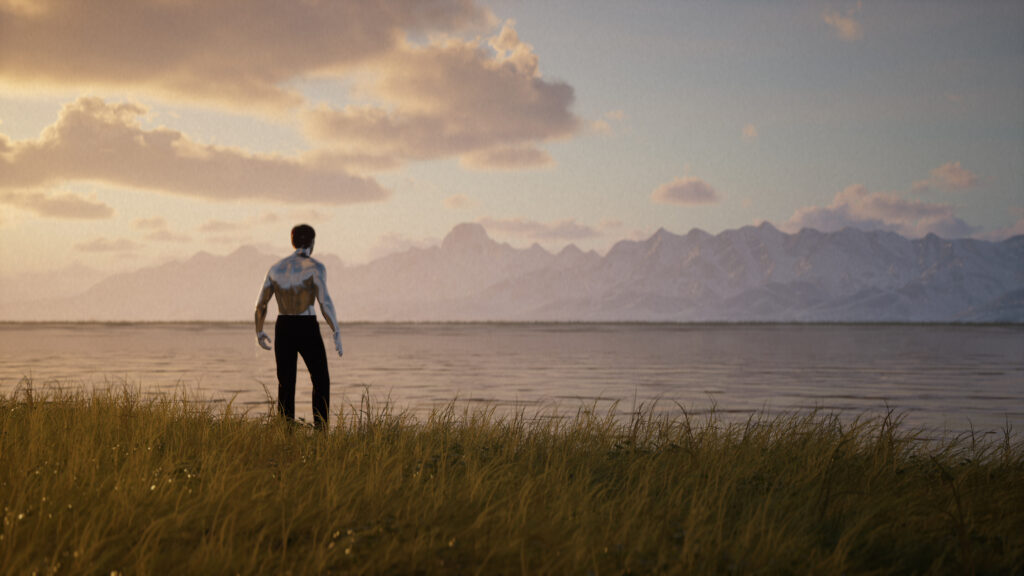
In the single-channel 3D animation “The Last Dream at the End of the World” Phuntsog contemplates the end of the world. A character in the likeness of the artist, with skin that has suddenly turned metallic, represents the sole person left on the planet. He has evaded the rising ocean waters and managed to freely reach the Tibetan plateau, the highest landscape on Earth, because there is no longer anyone there to stop him.
The animated landscape is based on actual satellite imagery and terrain mapping databases of the area combined with other elements such as the rising waters and some vegetation or fictionalized projections of the area under extreme changes in climate, while the character’s movements use motion capture of Phuntsog’s actions.
“For the first time in my life I am able to see a human form that was modeled after my own image moving in the Tibetan landscape.” TP
The area, which is the actual birthplace of the artist’s mother, has Tibet’s highest mountain Mount Kailash as its backdrop and is the site of two spiritual lakes that link to the sources of Tibet’s four rivers, which Tenzin describes as “points of geopolitical tension downstream” in our present day. And it is there, in the company of a single horse and a few friendly crows, one of which speaks Mandarin, that the video’s character experiences humanity’s last dream.
_
Tenzin Phuntsog is a Tibetan-American artist working with the mediums of film, installation, multi-media, and performance. His works have previously exhibited at The Rubin Museum, New York, the Tang Teaching Museum & Art Gallery, Saratoga Springs, NY; House of Media Art, Oldenburg, Germany (solo); Seoul MediaCity Biennale, Seoul, South Korea; Berlinale, Berlin, Germany; Galerie Vermelho, São Paulo, Brazil; Video Brasil, São Paulo, Brazil; and The Museum of the South Atlantic, Galerias Municipais, Lisbon Portugal, among others.
Screenings and festivals include Museum of Contemporary Art (MoCA), Los Angeles, CA; Asian American Arts Alliance, New York, NY; Tang Museum, Sarago Springs, NY; Anthology Film Archives, New York; BlackStar Film Festival, Phildelphia, PA: FIDMarseille, Marseille, France; The Eye Filmmuseum, Amsterdam, The Netherlands; The Rotterdam Film Festival (IFFR), Rotterdam Film Festival, Rotterdam, The Netherlands, and many others. Recent Fellowships and residencies include SFFILM FilmHouse Residency, San Francisco, CA (2025); Marble House residency (2022), NARS Residency (2021), and a Flaherty Fellowship (2019). Tenzin Phuntsog current lives and works in San Francisco, CA. He received a BA in Media Arts from the University of California (UCLA), Los Angeles and an MFA in Visual Arts from Columbia University in New York.