Peggy Ahwesh
Navigations
November 6 – December 13, 2025
Opening Thursday November 6, 6-8pm
Selected Press:
Art in America, by Tessa Solomon
Artforum Must See
Ines Magazina, by Yohanna M. Roa
Installation Views
Microscope is very pleased to present “Navigations” as the fourth solo exhibition at the gallery by Peggy Ahwesh.
Through original imagery and footage of airplane flights captured within a mid-2000s 3D flight simulation computer game, the artist’s new video installations and photographic works in “Navigations” address notions of power, control, lost histories, displacement, and freedom, especially in times of oppression and war.
“…What does it mean to be free to fly? To take to the skies? To cross borders without concern…” — Peggy Ahwesh
Mainly situated within the Eastern Mediterranean ares of the occupied West Bank, Lebanon, and Syria, the works on view also draw upon the artist’s personal experience as a second generation Syrian-American and her time in the early 2010s living and working in Ramallah.
Two video installations were inspired by Ahwesh’s visit to a now-abandoned airport located between the village of Qalandia and Jerusalem that was once a bustling hub transporting locals, businesspersons, pilgrims, diplomats, politicians, and movie stars in its early-to-mid 1960s heyday. The airport, which has been known under three names — Qalandia, Jerusalem International Airport, and Atarot — and has been under the control of three governments — British (1924-1948), Jordanian (1948-1967), and Israeli (1967-present) — saw its last commercial flight take off 25 years ago.
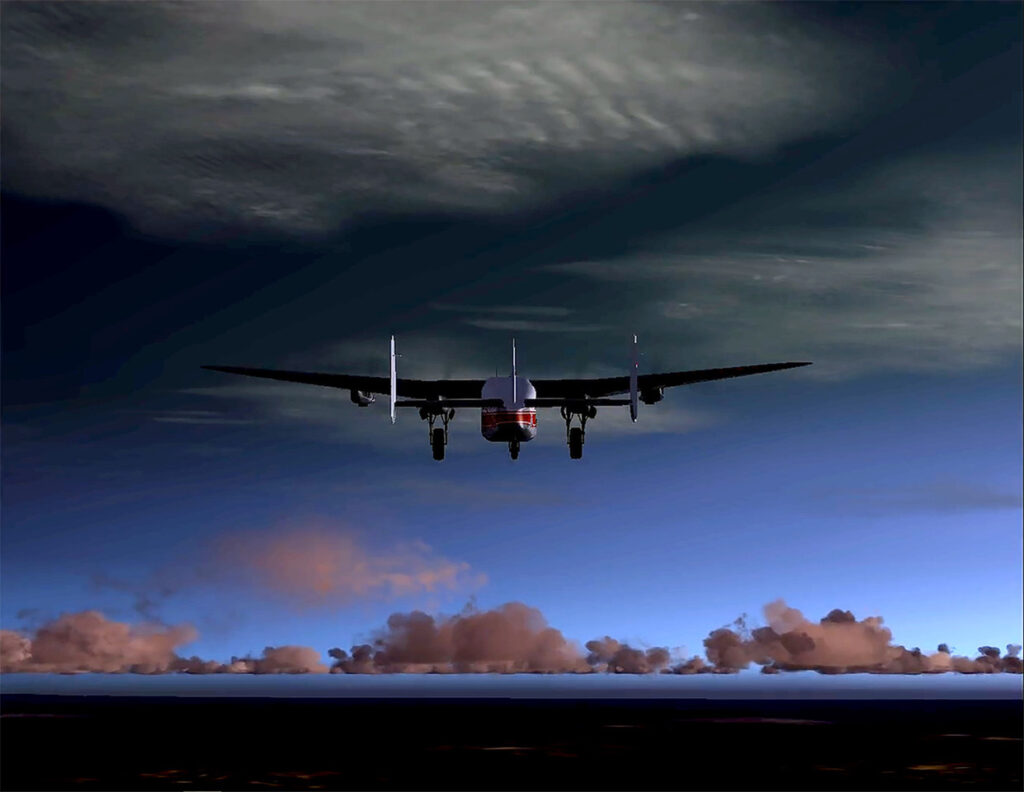
The new large-scale installation “The Wayfinders” consists of five video projections and rotating floor fans. Each of the 5 screens depicts a single, imaginary flight created through multiple navigations of the game “Flight Simulator 2004: A Century of Flight,” including: 1) a daylight out of Beirut over the coastal mountain range towards Damascus; 2) a southern flight from Beirut with clear skies turning to stormy weather over a ruined landscape (is that Gaza?); 3) a night flight from the Qalandia/Jerusalem airport to the Old City; 4) a conventional daytime round-trip flight from Qalandia/Jerusalem and Damascus; and 5) a flight with featuring only the night sky and constellations, “figures from old Arabic star lore that would be night guides and story tellers to earlier cultures.”
Using accurate 3D recreations of the airports and aircrafts from the 1960s, Ahwesh expands the work across time, space, and realities through the game’s other features and settings, which allow for such detailed choices as time of day, weather patterns, and the type and movement of clouds. Ahwesh, similarly to her previous work of machinima “She Puppet” (2001), frequently breaks the rules of the game, such as flying within city limits or crashing the plane to reveal unexpected imagery. The soundtrack features a poetic voiceover of historical, political and personal stories that is augmented by the sound of the whirling fans.
The two-channel video “Qalandia” is made entirely with footage Ahwesh recorded in the mid-2010s when she and a friend “broke into” the abandoned airfield, which is still under the Israeli government’s control. Ahwesh sees the decaying airport as emblematic of the politics of the area where, she says, “Land and ownership and privilege are always contested, and power is enacted through land grabs.” Over time, the silent runways and deserted facilities are gradually being reclaimed by nature.
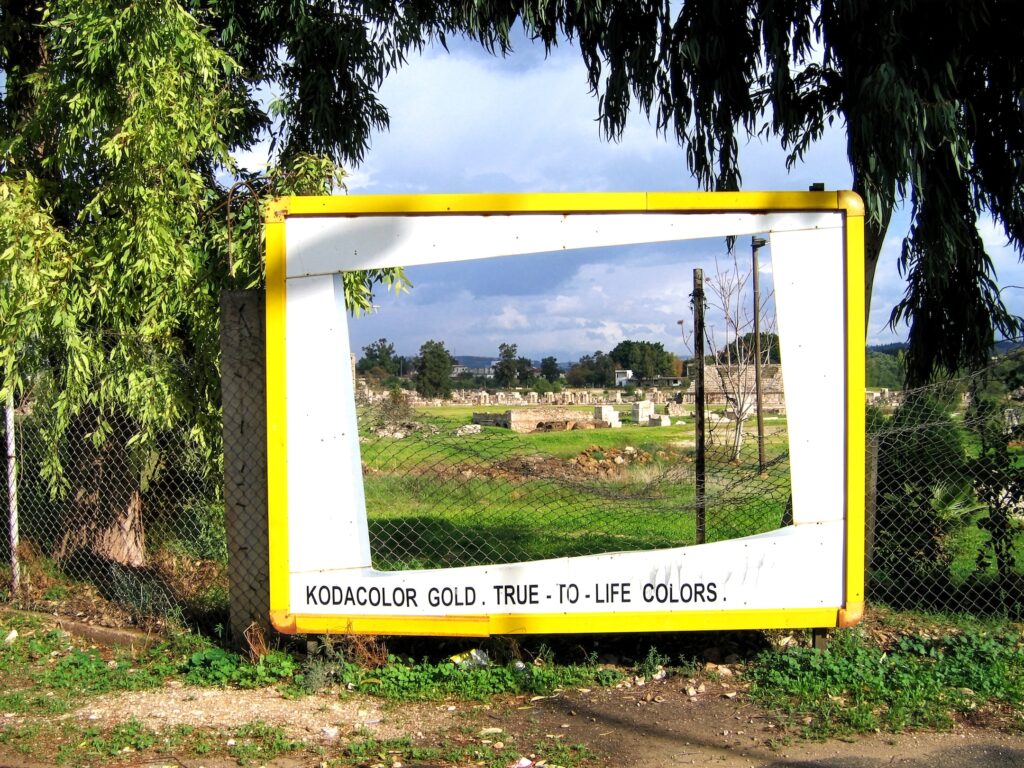
Finally, never-before-seen photographic works shot in Lebanon, the West Bank, and Syria by Ahwesh from as early as 1990 reflect her personal ties to these territories as well as her distance from them, as she assumes the perspective of an American visitor. In newdiptych compositions the artist pairs images of Palmyra’s Temple of Bel before ISIS’ destruction with Trump’s prototypes at the US-Mexican border, and a photograph of her father’s ancestral village with one of her younger self sitting by a museum in Palmyra. Other works featuring old billboard ads for Kodak film slides and Nokia cellphones inadvertently trace parallels between the gradual disappearance of civilizations and the transiency of technologies that aim to offer advancements.
“Peggy Ahwesh: Navigations” runs from November 6 to December 13, 2025. Opening Reception: Thursday October 30 from 6-8pm. Gallery Hours: Tuesdays – Saturdays, 12-6pm. For high res images or additional information please contact the gallery at info@microscopegallery.com
“The Wayfinders” Credits: Nico Cadena (Pilot & Flight Tech); Grey Gersten (Composer); Marianne Shaneen (Writer); Mohammad Balaweh (Sound Artist); Ben Coonley (Technical Assistance); Keith Sanborn (Technical Assistance).
_
Peggy Ahwesh is an artist working primarily with film, video, and installation whose practice is an inquiry into feminism, cultural identity and genre. Her work engages political and social topicality, handled with theoretical rigor, while at the same time using humor and mistakes in an open embrace of the inexplicable. Her works have screened and exhibited extensively in the US and internationally.
Institutional exhibitions include at the Museum of Modern Art (MoMA), New York, NY; The Whitney Museum of American Art, New York, NY; The Kitchen, NY, NY; Pompidou-Metz, Metz, France; Kunsthall Stavanger, Stavanger, Norway; Spike Island, Bristol, UK; JOAN, Los Angeles, LA; and George Eastman Museum, Rochester, NY (on view through November 2), among others.
Ahwesh has received numerous grants and awards including from the Guggenheim Foundation, Jerome Foundation, Creative Capital, New York State Council of the Arts (NYSCA)and the Alpert Award in the Arts. She is the recipient of the 2025 Stan Brakhage Vision Award.
Her works are in the permanent art collections of the Hirschhorn Museum and Sculpture Garden, Washington DC; the Museum of Modern Art (MoMA); and the Carnegie Museum of Art, Pittsburgh, PA, among others. Peggy Ahwesh was born in 1954 in Canonsburg, PA and lives and works between Brooklyn, NY and the Catskills.