
Frank Gillette
Spectra Obscura
September 10 – October 17, 2026
Opening Thursday September 10, 6-8pm
Courtesy of the artist and Microscope Gallery, New York
Press:
Hyperallergic, by Anthony Hawley
The Brooklyn Rail, by Andrew Woolbright
Sacrificial reverence for things past, matched with equal irreverence for the intricate balance of nature, has brought the species to within clear sight of doom. — Frank Gillette, from Radical Software, Number 1 (1970)
Microscope is very pleased to present Spectra Obscura, a solo exhibition of new, recent, and historic works by the groundbreaking video and installation artist Frank Gillette.
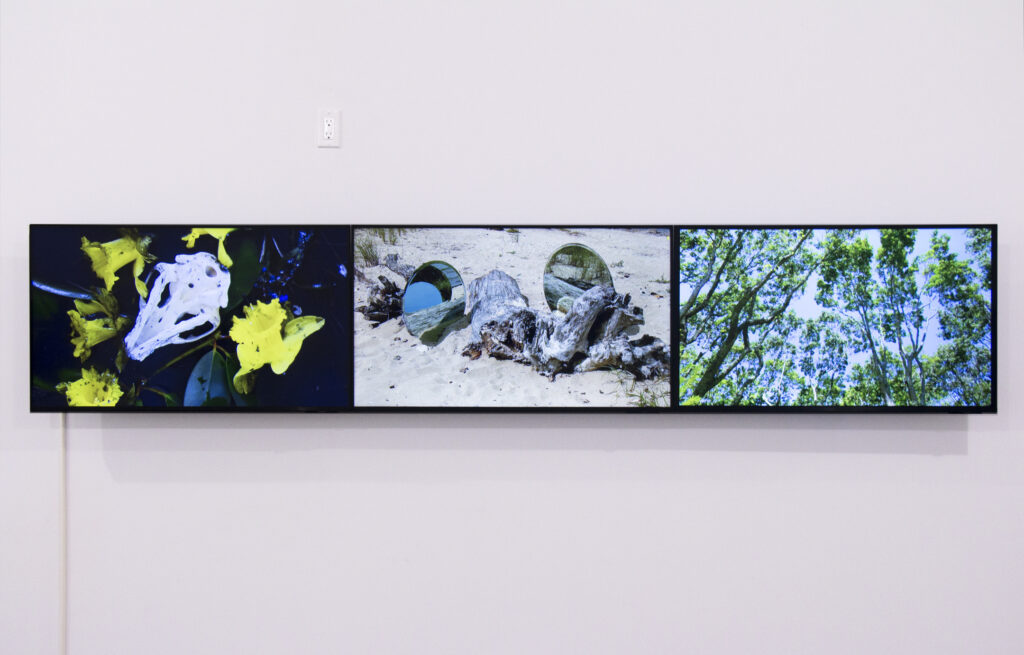
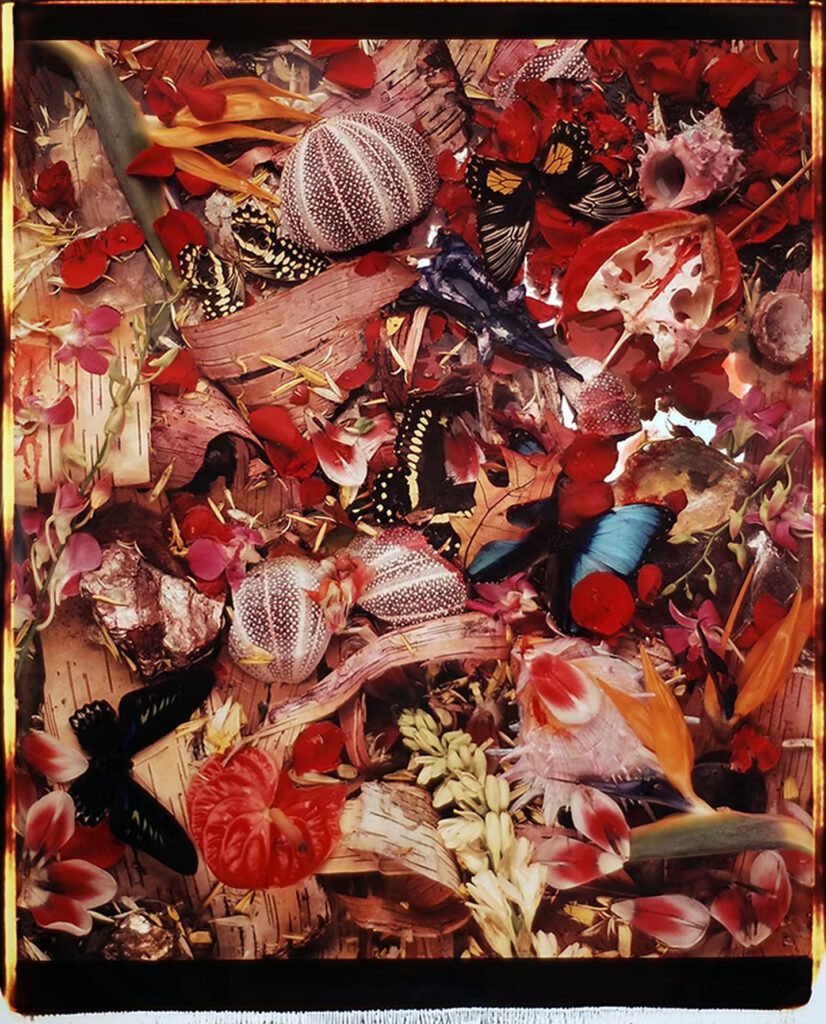
The show marks the New York debut of Gillette’s complete The Symbiotic Blues, a trilogy of 3-channel video works completed between 2017 and 2022, on view with selections from his 1987, 20 x 24-inch Polaroids series Chthonic Chimera, and two early videos, Hark! Hork! (1972-73) and Symptomatic Syntax (1981), among others.
Since the 1960s, Gillette has employed video technologies in visionary, experimental works rooted in the mediated perception of the self and concerns for the environment, especially in relation to humans’ seemingly inexorable journey towards ecocide. In his works, the term “ecology” also extends to “media ecology,” in which technological ecosystems bring about awareness, social change and, ultimately, new cultures. The title of the show references the camera obscura, considered as the first known device capable of rendering images of our surrounding world.
Gillette’s The Symbiotic Blues conveys nature’s fragility and resilience, as well as the urgency of its ongoing devastation, through three 3-channel video installation works. Utilizing the pictorial tropes of landscape and still life in video form, the series gradually shifts from Riverrun’s ( 2017-2018) pastoral scenes to Spearlight’s (2019) kaleidoscopic digital manipulations and Blackseer’s(2022) increasingly somber and cataclysmic scenarios. Each consists of three separate video channels of varying durations, resulting in never-repeating combinations suggesting the perpetual time of ecologic life. Mirrors, recurrent elements of Gillette’s, appear frequently on beaches and in woods where they are used to generate disorienting optical illusions. Fragments of broken mirrors accentuate the sense of nature’s vulnerability.
“My work has always dealt with the natural world in all its guises and The Symbiotic Blues is the latest invocation of these complexities. While employing video in the late sixties with Portapaks given to me by Marshall McLuhan, new technologies have allowed me to capture details extending my visions. All nine channels revolve around the woodlands and beaches of eastern Long Island, which are fecund with wildlife and botanical forms. Being immersed in such an environment became a data bank of processes generating the osmotic spectrum between nature and culture.” — FG
His Polaroid series Chthonic Chimera were photographed with one of only a handful of 20×24 cameras produced in the late 1970s. Composed of unlikely assemblages of sea shells, flowers, butterfly wings, coral skeletons, insects, stones, and other elements the artist gathered and staged, these images preserve the breadth and transient beauty of natural life in photographic tableaux.
Standing in dialogue with the Polaroid series, the 1981 video Symptomatic Syntax depicts a changing aquatic environment of plant and other natural specimens, at times stationary and at others floating. Overtime, the familiar life forms become increasingly abstract and acquire uncanny colorations. The accompanying sounds feature various running water sources and a woman’s voice delivering philosophical arguments about the “unreality of time” from the 1908 book by J.M.E. McTaggert.
With the single-channel video Hark! Hork! (1972-73), which was included in the 1975 Whitney Biennial, Gillette offers an ode to our planet that also serves as a study of early video’s ability to capture the grace and might of the environment. Taking its name from a dream sequence in Finnegan’s Wake, the piece is constructed as an intricate montage of black and white imagery of the ocean, sky, waterfalls, fields, seagulls, and a limulus, among others. Floral still lifes are juxtaposed with a strobing installation of white flowers and triangular mirrors in the artist’s studio. Gillette integrates within the work’s mostly music-based soundtrack recitations of Molly Bloom’s soliloquy in Ulysses, a passage from T.S. Eliot’s The Waste Land, and a rendition of Blake’s The Sick Rose by Allen Ginsberg.
In Rio Grande River Bed (1974) we find the arid, cracked river bed of the Rio Grande as photographed by the artist in 81 color instant Polaroids and set in a large grid. Whether due to seasonal low flows, climate change, man-made water diversions, or all of these, this fragmented depiction of a former life-giving waterway registers today as a haunting 50-year old warning.
Spectra Obscura opens on September 10 and continues through October 17, 2026, with an Opening Reception on Thursday September 10 from 6-8pm. For further information please contact the gallery at info@microscopegallery.com.
_
New York artist Frank Gillette (b. 1941) is an American media artist and pioneer of video art. He began filming on the streets of New York in 1968 with borrowed Sony Portapak cameras from media theorist Marshall McLuhan. Additionally, he has produced a large body of photographs, drawings, paintings and texts. In 1969, he co-founded the Raindance Corporation, a video collective whose goal was to explore the utopian, socially critical, participatory, and emancipatory potential of the newly available medium of video. In the context of the US counterculture of the late 1960s, Raindance challenged the monopoly of commercial television and attempted to create a counter-public sphere in the media. Additionally, a central medium for this was their magazine Radical Software. In numerous works, Gillette used the medium of video to empirically investigate ecological systems, environments, and taxonomies. He was one of the first artists to work with multi-channel video installations, as early as 1968 with his 4-channel piece “Keep,” and a year later with “Wipe Cycle” (a collaboration with Ira Schneider) that was exhibited at the Howard Wise Gallery in the show “TV as a Creative Medium.” His work is in numerous collections, including the Museum of Modern Art, New York; the Whitney Museum of American Art, New York; the Everson Museum, Syracuse, NY; Tate Modern, London, UK; and ZKM. Karlsruhe, Germany, among others. He is the recipient of fellowships from the Rockefeller Foundation and the Guggenheim Foundation as well as grants from the New York Council of the Arts, the National Endowment for the Arts, and in 1984 he was appointed as artist-in-residence at the American Academy in Rome. Currently, his work is on view in “Collection 1950-1980” at the Museum of Modern Art, in New York.
Courtesy of the artist and Microscope Gallery, New York